Overview
October - May: 8:30 a.m. - 5 p.m.
June - Sept.: 8:30 a.m. - 5:30 p.m.
Closed New Year's Day, Thanksgiving, and Christmas.
Parking: No fee
Entrances off Wildcat Canyon Road and Grizzly Peak Boulevard,
Shasta Rd, Berkeley, CA (Directions)
Garden Entrance:
1550 Wildcat Canyon Rd.
Berkeley, CA 94708
(510) 544-3169
Toll Free: 888-EBPARKS (888-327-2757), option 3, extension 4507
Internet & Cellular Access

Check AT&T, T-Mobile & Verizon Coverage.
Select 'Map Layers' and switch on 'No Data Coverage Areas'
Public Wi-Fi Available.
View Tilden Attractions (PDF) for a list of current hours and contact details.
In 2020, the North American Rock Garden Society (NARGS) awarded the Frank Cabot Public Rock Garden Award to the Regional Parks Botanic Garden in recognition of the outstanding rock garden and plantings.
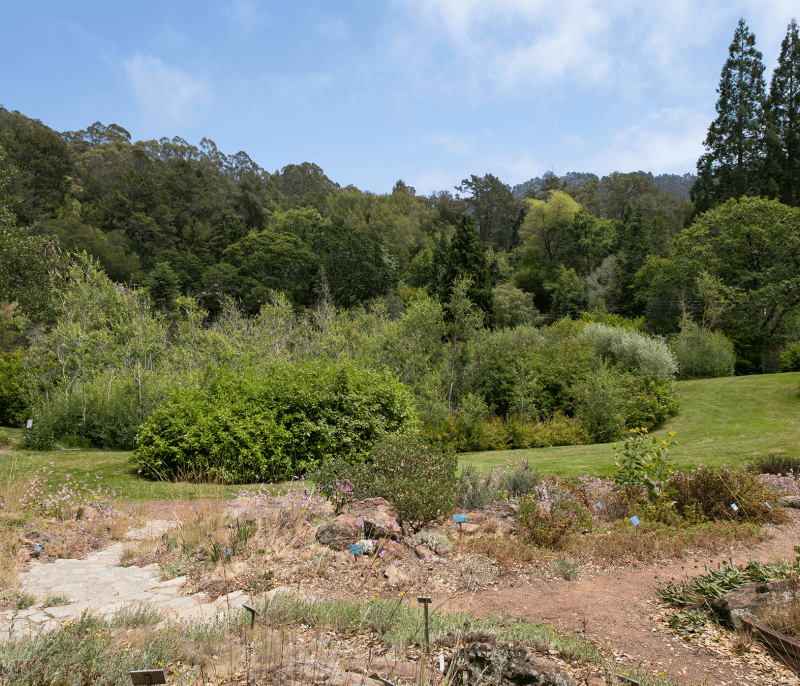
The Regional Parks Botanic Garden was founded on January 1, 1940. Situated in Tilden Regional Park's beautiful Wildcat Canyon in the heart of the north Berkeley Hills, the garden is devoted to the collection, growth, display, and preservation of the native plants of California. The state is a vast region of many floral areas, such as seacoast bluffs and coastal mountains, interior valleys, arid foothills, alpine zones, and two kinds of desert. California embraces nearly 160,000 square miles - imagine 160,000 square miles of California set in a garden that can be walked in a day.
The public is welcome in this garden, see opening hours above. All specimens are landscaped into a delightful setting, offering many enjoyable days of exploration, relaxation, and contemplation. To the student, the Botanic Garden offers the premier Northern California venue in which to study the state's native plants without wandering far from home or dorm. Indoors, in the Visitor Center, lectures and slide shows are scheduled on most Saturdays from November through February, and an exhibit pertaining to the native flora is usually to be found in the auditorium.
Notable among the many specimens that have been brought in from all corners of the state are representatives of nearly all the state's conifers and oaks, and probably the most complete collections of California manzanitas to be found anywhere. There are also extensive collections of California native bunchgrasses, bulbs, aquatic plants, and representatives of about 300 taxa that are classified in the California Native Plant Society's landmark study, "Inventory of Rare and Endangered Vascular Plants of California."
Notice: Dogs are not allowed.
Notice: Reservations are required for use of the Botanic Garden for ALL commercial, wedding, individual or portrait photography/filming, or group gatherings. To make a Reservation, call Botanic Garden Office at (510) 544-3169; Monday through Friday, 9 a.m. - 3 p.m. All Reservation requests must be made 31 business days before your event date.
Fees:
- Resident of Alameda and Contra Costa, $125 per hour
- Non-resident, $200 per hour
- $500 deposit
- $8 non-refundable service fee
To Reach The Park
Maps

Park Accessibility
The Botanic Garden is only partially accessible to wheelchair users as it includes steep grades, stone pathways, and irregular narrow trails. The paths that contour around the garden to the right and left, approximately 50 to 100 feet from the main entrance, offer views of the garden.
Attractions
The State in 10 Geographically Based Sections
For the sake of clarity of display, the majority of the garden is divided into ten geographically-based sections. The sections are: Southern California (plants designated by sand-colored labels), Shasta-Klamath (green labels), Valley-Foothill (yellow labels), Santa Lucia (orange labels), Channel Islands (black labels), Sierran (blue labels), Redwood (red labels), Sea Bluff (brown labels), Pacific Rain Forest (green labels), and Franciscan (yellow labels). The Canyon (brown labels) section, at the northernmost part of the garden, is not geographically based. Here, the plants are grouped according to their individual horticultural requirements.
There are also three subsections: aquatic plants, coastal dune plants, and the Antioch Dunes of Contra Costa County.
The Best Times for Blooms
Each year in the Botanic Garden, the first plants to bloom do so around mid-December and early January, initiating a flowering succession that makes a continuous show for fully seven months. No month is devoid of plants of some attraction or other. The following schedule lists the more prominent plants and the months in which they are usually at their best.
| MONTH | PROMINENT PLANTS |
|---|---|
| January | silktassels, manzanitas, manzanitas, and more manzanitas, osoberry, currants |
| February | barberries, Dutchman's pipe, fuchsia-flowered gooseberry, milkmaids, western leatherwood, bluff wallflower, scoliopus |
| March | redbud, pink-flowering currant, California poppy, trilliums, shooting stars, wallflowers, fritillaries, fawn lilies, rock cress, pussy willows, trees begin to leaf out |
| April | California rose-bay or rhododendron, woolly blue curls, ninebark, mountain spiraea, summer holly, main ceanothus groups, Chinese houses, irises, storax, blazing star |
| May | monkeyflowers, fremontias, carpenteria, tidy tips, bush poppies, brodiaeas, mariposa tulips, cacti, clarkias, mock orange |
| June | western azalea, matilija poppy, fireweed, ocean spray, sweetshrub, mariposas, Donner buckwheat, clarkias, columbines |
| July | red and yellow bush penstemons and other perennial penstemons, scarlet mimulus |
| August | wild buckwheats, late penstemons, evening primroses, gum plants, scarlet larkspur, Milo Baker's lupine |
| September | California fuchsias, tarweeds, buckwheats, hibiscus, helianthus, late penstemons |
| October-November | fall color of snowberries, berries of the madrone, leaves of cottonwoods, deciduous oaks, dogwoods, hawthorn, willows, vine maple, chaparral currant blooms |
| December | first manzanita blooms, colorful twigs of deciduous shrubs |
For more information on the Botanic Garden, classes, or events, visit Friends of the Regional Parks Botanic Garden web site at http://www.nativeplants.org/. For more information about volunteer opportunities, call the garden at (510) 544-3169.
Plant Sales
For information and updates about the Regional Parks Botanic Garden's biannual plant sales please visit the Friends of the Regional Parks Botanic Garden website at https://nativeplants.org/.
Docent Tours
Docent-led tours are currently being offered every Saturday at 2pm and Sunday at 11am and 2pm. Meet at the Visitor Center. Max number of spots is ten per tour. The Botanic Garden is closed New Year's Day, Thanksgiving, and Christmas.
Guidelines for Visitors
The Regional Parks Botanic Garden is a beautiful living museum.
Please respect its mission by following our rules:
- Walk on paths or lawns, not in plant beds.
- Stay off rocks.
- Provide adult supervision for children at all times
The following activities are prohibited:
- Removing plant parts or specimens
- Removing gravel, rocks, or soil
- Bringing dogs into the garden, except service dogs
- Riding bicycles (park and lock your bike or walk it around the garden)
- Climbing trees or shrubs
- Throwing frisbees, balls, etc.
- Playing loud music
- Running